Fan of Full Fathom Five? Be sure to check it out at its new home!
Showing posts with label Books. Show all posts

Tuesday, March 20, 2012

SF Maritime NHP on Worldcat.org


Search for an item in libraries near you:
WorldCat.org >>


We are delighted to announce that the Park's published holdings (e.g., books, periodicals, etc.) and some records for archival holdings are now appearing on Worldcat.org! New acquisitions are listed on our Worldcat.org profile page, where you can also subscribe to an rss feed of our newly cataloged items.

If you haven't visited Worldcat.org, be sure to check out the advanced features that allow you to create bibliographies and lists, and to tag and share items using multiple services.

Although the newest, Worldcat.org is just one of the many catalogs that contain records for the Park's collections. And as ever, be sure to contact us if you have questions about using any of these catalogs to locate our Park's resources.

Mirrored from Full Fathom Five, due to its lack of rss feed & functioning commenting.

Wednesday, March 07, 2012

A Gold Rush Journal 'Round the Horn - More than Latitude and Longitude


(by Palma J. You, Archives Technician)

Receipt (recipe) for cholera (SAFR 14200/HDC 91)

The H. W. Chittenden sea journal kept on board the Croton, San Francisco Maritime National Historical Park Museum and Archive Collection (SAFR 14299, HDC 91), gives us a daily perspective from February 16 to July 29, 1849 of life aboard a Gold Rush ship. Mr. Chittenden, an engineer, sailed from New York to San Francisco around Cape Horn. In 19th century language and spelling, his journal is filled with the goings-on and sketches in pencil of sites and landings along the way and other historical information including a provocative remedy for cholera. Sketches and other neat stuff from the journal will be posted over the next several weeks as a series. The first of this series is a remedy for cholera:

Receipt for Cholera
10 grains of camphor
20 do Red Pepper
20 do Of callomel
And rub the Boddy with some stimulating ointment. If this does not opperate, repeat the doce after some suficient time has elapts for its action upon the Bowels.

Here's a nice example of 19th century word usage and spelling. The way the words "Receipt" and "do" are used is intriguing. A little research shows the word "Receipt" could mean "a statement of ingredients and procedure necessary to make a medicinal preparation" - a perfect fit; and "do" is probably the abbreviation of the word "ditto" (OED online). To give "Grains" context, 20 grains make 1 scruple, 480 grains make 1 ounce. In 1888 the United States used the same apothecary scale as used in Great Britain (Clarke). And, "callomel" is listed as a "valuable cathartic given at the beginning of an illness, where it is desired to clean out the bowels completely." (United States Public Health Service). It makes sense this recipe shows up early in the journal.

Etymologies for 19th century usage of the words "Receipt" and "do" can be found in the Oxford English Dictionary. Second edition, 1989; online version December 2011 (subscription required).

Other sources:

Clarke, Frank Wigglesworth. Weights, measures, and money, of all nations. New York: D. Appleton & Co.

Medical Officers of the United States Public Health Service. The Ship's Medicine Chest and first aid at sea. Washington: United States Government Printing Office, 1929.

Mirrored from Full Fathom Five, due to its lack of rss feed & functioning commenting.

Thursday, February 23, 2012

Lobster a l'United States


The recipe for Lobster à l'United States in The Captain's Table : 18 recipes for famous dishes served aboard the S.S. United States and S.S. America is preceded by a portrait of a happy couple with the following caption:

'Months after a recent trip abroad, we were still savoring the memory of Lobster à l'United States served on board the S.S. United States. On our next crossing, we asked the Maitre d' for the recipe. Here it is--just the way M. de la Motte wrote it out for us.' Colonel and Mrs. Leon Mandel, well-known Chicago financier and woman's world shotgun champion, respectively, have made 20 crossings on United States Lines.

Here is that recipe:

Lobster à l'United States

Crack the claws and cut the tails of two 1-1/2 pound live lobsters into thick slices. Reserve the rest of the lobsters for another use. In a flame-proof casserole sauté 1 carrot, 1 leek, 1 stalk of celery and 2 shallots, all finely chopped in 2 tablespoons clarified butter for 7 to 8 minutes. Stir in the lobster pieces and add grated lemon rind, paprika, cayenne and salt to taste. Cover the casserole and bake the mixture in a very hot oven (450° F) for 8 to 10 minutes. Remove the casserole from the oven and put it over high heat to reduce the remaining liquid. Pour 3 tablespoons heated brandy over the lobster and ignite the spirit. When the flames die dust the lobster with 3 tablespoons flour and stir in 1 tablespoon tomato paste. Add 4 cups chicken stock, bring it to a boil, and cook the mixture, covered, over very low heat for 5 minutes, stirring occasionally. Stir in 1/2 cup heated heavy cream. Remove the casserole from the heat and sprinkle it with chopped truffles and fines herbes. Stir 1/4 cup sherry and serve the lobster with saffron rissoto (rice) or croutons. Serves 4.

And you can see the March 2, 1954 menu from the S.S. United States when this dish was served, along with kangaroo tail soup, at the New York Public Library's What's on the Menu collection.

Mirrored from Full Fathom Five, due to its lack of rss feed & functioning commenting.

Wednesday, February 15, 2012

Overtaking


Overtaking

Every ship under steam, and indeed, under sail,
Overtaking another is never to fail
To alter her course in order to steer
Quite clear of the other when drawing too near.

Another instructive rhyme from Nautical Nursery Rhymes, by Billy Ringbolt, which resides in the Peterson, Peter H. (Capt.) Papers, (SAFR 18665, HDC 571).

Mirrored from Full Fathom Five, due to its lack of rss feed & functioning commenting.

Wednesday, February 08, 2012

From dandyfunk to cracker jack?


Among the treasures in the Library's Krummes Collection of Steamship Fiction are selected issues of rare pulp magazines such as Adventure, containing maritime stories and poetry. Not all of these stories are fiction; some are memoirs by sailors-turned-authors, and in cataloging them, I'm learning a lot. (Since many of these stories are written by noted authors and never reprinted, we decided to create individual cataloging records for each maritime story, poem, or article, so they would be easier to locate, and so far I've created cataloging records for the issues we hold of Adventure magazine from 1919 through mid-1930.) One such memoir is Norman Springer's "Dandyfunk," which describes fondly the "lost and forgotten art" of how Old Donald made dandyfunk at sea. He is careful to delineate the proper steps in making dandyfunk, and to distinguish it from cracker hash, which anyone could make. The ingredients are listed in great detail:

  • hardtack placed in a dandyfunk bag which was laid on the iron anchor stock and beaten with a blub, oaken belaying pin, or heavy sheet pin, and emptied onto a plate
  • water, "not too much and not too little" added to the heap of crumbs and carefully stirred
  • and other ingredients added, "everything a hungry man could lay hands upon that looked edible."

Although sugar and molasses are mentioned, and he calls it a "candy-sweet, greasy, lead-heavy sailors' delight," Springer doesn't state just what in fact it is--a pudding? A cake? A casserole? A big cookie?

Basil Lubbock in Round the Horn Before the Mast says that dandyfunk is a mixture between a cake and a pudding, and in Warren Harper's article, "Housekeeping on the High Seas" (in the Boston Cooking-School Magazine vol. 8, no. 10, May 1904), we learn on p. 483 that dandyfunk a kind of deep-sea gingerbread. Sounds tasty! But in Saltwater foodways : New Englanders and their food, at sea and ashore, in the nineteenth century, Sandra Oliver introduces her recipe on p. 116-117 by saying, "I don't know why you would want to make this, but here is an adapted recipe in case you do." The ingredients she lists are simply 1 piece of hardtack, 1 tablespoon of shortening, and 2 tablespoons molasses.

This version does not sound as appetizing, and doesn't sound like a "sailors' delight." Clearly, somewhere between "everything a hungry man could lay hands upon that looked edible" and the simplicity of Oliver's recipe is what Springer says "was something to remember and dream over." So how can we capture the taste of a dandyfunk today?

If you contact us, we can get a copy of Oliver's recipe to you as a starting point (as well as a hardtack recipe). Many sailors' snacks took advantage of hardtack and molasses, including midshipman's nuts, which is described in the Encyclopedia of Nautical Knowledge as made of broken up sea-biscuit and raisins, so maybe your dandyfunk would benefit from raisins. How about peanuts? Robert McKenna's Dictionary of Nautical Literacy does not have an entry for dandyfunk, but tells us in the entry for Cracker Jack, "The combination of caramel-coated popcorn and peanuts is believed to have been inspired by a number of sea dishes, including 'crackerjack,' a combination of preserved meat and broken biscuits, and 'dandyfunk,' a mixture of broken biscuits and molasses."

Could a taste of Cracker Jack hint at the dandyfunk of yesteryear? I have to say, I'm not sure. McKenna does not cite any sources for his assertion, and the Oxford English Dictionary says that the term "cracker jack" as a culinary term (definition 2) dates in print to only 1902 when it was mentioned in the Sears catalog. (And the OED does not mention any link between dandyfunk and cracker jack in its entry for dandyfunk.)

What do you think? Have you made dandyfunk? Would you like to? We'd like to hear from you if you do! And if you come across any more information on dandyfunk, please let me know.

Mirrored from Full Fathom Five, due to its lack of rss feed & functioning commenting.

Wednesday, February 01, 2012

Digging for Gold at the Library: Howard Pease


(by Gina Bardi, Reference Librarian)

In a research library such as ours, fiction books are sometimes overlooked. Of course fiction is often mined for academic and research purposes (a quick check of WorldCat shows over 1,000 books about Moby Dick alone--that's a whole lotta whale), but let's not forget the pleasure of simply just reading for readings sake a good rousing tale of mystery or adventure. One of the most beloved fiction authors in our library is Howard Pease. Anyone who reads a Howard Pease book usually ends up reading two, then three and well, so on and so forth. I like to call it "The Policy of Apeasment", but only quietly to myself lest I face the moans of a bad pun. Pease wrote his books mainly for a juvenile audience, but his sense of narrative and powers of description appeal to adults as well. Titles such as Jinx Ship, The Tattooed Man, and the Ship Without a Crew speak to his ability to pull a reader into the story. Who wouldn't want to read a book entitled Shipwreck; the strange adventures of Renny Mitchum, mess boy of the trading schooner "Samarang."

Covers!

Cover of The Tattooed Man

Cover of book Heart of Danger

Our library has over 20 Howard Pease books, including one in Danish, so there is enough here to keep you going for a while. Howard Pease fan extraordinaire Dan Glines has compiled a list of all of Pease's book with descriptions of the plots to make it easier to pick one to start, Books by author Howard Pease reviewed, which is available in the Library, as is the thesis A study of the creative genesis of the twenty-two published children's novels by Howard Pease.

Start your descent into Peasemania today!

Mirrored from Full Fathom Five, due to its lack of rss feed & functioning commenting.

Wednesday, January 25, 2012

December's new titles in the SF Maritime NHP Library


Here are the Library's lists of new acquisitions for December. For more information on any title, contact us or search our catalogs:


Mirrored from Full Fathom Five, due to its lack of rss feed & functioning commenting.

Wednesday, January 18, 2012

Digging for Gold at the Library: Jeannette


(by Gina Bardi, Reference Librarian)

As winter settles in San Francisco, my mind turns towards all things cold. Arctic exploration is the coldest thing one can do, save for streaking on Pluto. The brave adventurers who set out to the literal ends of the earth to explore frozen landscapes have always been a great interest of mine. What would make someone decide this was a good idea when so few ended well? It's more than the urge to push physical limitations or to be the first at something. No, there must be so much more than the desire for glory or the push of curiosity. I just hope it never calls to me because frankly, I'm freezing right now and it's only about 50 degrees outside. I believe I am half reptile because laying on a hot rock in the sun is way more my style than scrambling over ice shelves, but still--I love to read about polar exploits while wrapped in a blanket safely ensconced in an armchair by the fire.

While perusing our polar section, I came across this wonderful spine:

Spine of book, Our Lost Explorers

And cover:

Cover of book, Our Lost Explorers

For those who don't know, The Jeannette left San Francisco in 1879 with a crew made up of naval personnel and a few civilians in order to reach the North Pole. Things did not go as planned; when do they in the arctic? Only a handful of her crew were rescued in 1881 after an arduous trek over land and in open sea. Here's a brief account of the expedition.

I've heard of the Jeannette before, but I haven't read anything in depth about her. This book looks to be perfect introduction as it's a combination of personal narratives, documents, and beautiful engravings. Here's one of the ship being abandoned:

<br />Engraving of ship Jeannette being abandoned

It certainly must be the most wretched feeling in the world to see your ship crushed before you. Lieutenant Danenhower, the ship's navigator, had this to say of her sinking:

It was said that the ice first closed upon her, then relaxing allowing the wreck to sink; the yards caught across the ice and broke off, but being held by the lifts and braces were carried down; depth, thirty-eight fathoms, as I remember. The next morning the captain and others visited the spot and found only one cabin chair and a few pieces of wood--all that remained of our old and good friend, the Jeanette, which for many months had endured the embrace of the Arctic monster. (p. 206).


So while winter roars around you, and you retreat to the comforts of woolen socks and knitted scarves, remember those who have endured the embrace of the arctic monster and raise your cocoa mug to them.

Source: Newcomb, Raymond Lee; Bliss, Richard W. Our lost explorers : the narrative of the Jeannette Arctic expedition as related by the survivors, and in the records and last journals of Lieutenant De Long. Hartford : American Publishing Co., 1883, c1882.

Mirrored from Full Fathom Five, due to its lack of rss feed & functioning commenting.

Wednesday, January 04, 2012

Digging for Gold at the Library: Ways of the Sea


(by Gina Bardi, Reference Librarian)

Usually in my posts, I write about hidden or overlooked items in our collection. With a library as rich in material as ours, it's easy for little gems to be lost in the shelves. But sometimes, it's a good idea to trot out an old favorite and give it its due. If you aren't familiar with The Ways of the Sea by Charles G. Davis, then allow me to introduce you to your newest oldest best friend. This slim volume (179 pages of roomy print) is a mixture of encyclopedia, primer, yarns and good old fashioned advice. Reading it is like sitting down at the kitchen table with your sailor uncle--the one who's been everywhere and seen everything and knows just the way to reel in a curious mind. Here's a description of a poker game that was happened upon by a visiting crew in the middle of a chapter about binnacles (on p. 20). It's crammed with wonderful imagery and meaty tidbits about a sailor's life:

A cloud of smoke and smell came out that would have looked as if the entire forecastle were on fire in the daylight. Even in the dim light of the anchor light hanging on her forestay I could see it pouring out. As I climbed down the vertical forecastle ladder I could hear a crowd of men (smell them for that matter, there was no ventilation) and only when I got below the smoke line could I see that there was a game of poker going on with a highly excited crowd watching.

"Hello, you Wrights," was the greeting our boys got as we all landed below. For sailors were called by the name of the ship they came from in those times. And then the gang turned to watch the hand of poker finished.

The Dana's forecastle was the old style, built away up in the "eyes of her" or up on the bow under the deck. Big husky men half stripped--for it was close and hot down there with over twenty men packed into one small room--lay in their bunks; some sat on the edges of them with their legs hanging over and smoking "tar heel" tobacco. Those playing cards with a seachest for a table sat on upturned deck buckets or long sailmaker's benches.

An old coffee pot slush lamp, smoking like a bonfire of green leaves, gave out an uncertain flickering light like a lighthouse in a fog.


Whether you want to or not, you can smell it.

The short, easy to read chapters cover such divergent things as lights, washing down decks, stowing anchors and painting a ship at sea. This is the kind of book that answers questions you didn't know you had, which are my favorite kind of questions. In fact my only criticism of the book is that he sometimes begins intriguing tidbits that he doesn't follow up on. I'd like the book to be twice as long.

The library has two copies available, so come on down and learn a little bit more about the ways of the sea.

Mirrored from Full Fathom Five, due to its lack of rss feed & functioning commenting.

Wednesday, December 21, 2011

Cold Eggs Muscovite


This recipe from The Captain's Table : 18 recipes for famous dishes served aboard the S.S. United States and S.S. America follows the one for Porterhouse Soup, and is introduced with the declaration, "Any egg would be proud and happy to end up looking like this."

Wow!

The recipe:

Slice off both ends of 6 hard-cooked eggs. Around the top, middle, and bottom of each egg wrap 3 anchovy filets, to resemble the hoops of a barrel. Put a small slice of truffle in the middle of each egg, to represent the bung of a barrel. Stand the eggs upright and carefully scoop out the yolks. Fill the centers with caviar, shaping it in a peak at the top of the eggs. Stand each egg in a cooked white artichoke bottom, and arrange the eggs in a circle on a platter. Garnish eggs and center of the platter with finely chopped aspic. Serves 6.

Since I had never heard of Eggs Muscovite, I did a little searching, and found an interesting variant recipe, "Truffled Eggs a la Muscovite," in The Boston Cooking School magazine of culinary science and domestic economics, Volume 15 (1911), in the "Seasonal Recipes" section by Janet M. Hill, p. 329-330:

Have as many rounds of toast, two inches and one-half in diameter, as there are persons to serve. Spread the toast, while hot, with butter. When cold spread with caviare mixed with a few drops of lemon juice. The smallest sized can of caviare and a teaspoonful of lemon juice will be enough for eight rounds. For each service have ready a small, cold, hard-cooked egg, from which the shell has been removed. Cut a slice from the rounding end of each egg, that it may stand level. To three fourths a cup of mayonnaise dressing beat in one-fourth a cup of consomme, in which a scant tablespoonful of gelatine has been softened and dissolved. When added to the dressing the gelatine mixture must be liquid but not hot. Roll the eggs in the mixture to coat completely, then set one on each round; or set the eggs in place and with a silver knife spread the dressing over them; sprinkle with chopped truffles, or garnish with four or more figures cut from slices of truffles, or leave plain. Chill thoroughly before serving as an appetizer at luncheon or dinner. Three fourths a cup of white sauce, made of rich chicken broth (or half cream), may replace the mayonnaise.

This recipe is accompanied by an image:

Truffled Eggs a la Muscovite

What to do with the leftover cooked egg yolks? Many cookbooks suggest them crumbled over salads--sounds delicious!

Mirrored from Full Fathom Five, due to its lack of rss feed & functioning commenting.

Wednesday, December 07, 2011

New in the SF Maritime NHP Library


The library's lists of new accessions for November are here--for more information on any title, contact us or search our catalogs:


Mirrored from Full Fathom Five, due to its lack of rss feed & functioning commenting.
Wednesday, November 16, 2011

Porterhouse Soup


Today we bring you another recipe from The Captain's Table : 18 recipes for famous dishes served aboard the S.S. United States and S.S. America. This is another dish that was served in the dining rooms aboard the S.S. United States, which has been adapted for the home kitchen--it not only gives us a glimpse into what was served underway, but a look at mid-20th century recipes for the home cook. Contemporary recipes are usually presented with ingredients lists followed by the cooking directions, and serve considerably less than twenty!


Porterhouse Soup


Have butcher bone a 3-pound shin of beef and a 3-pound shin of veal and cut the bones into very small pieces. Spread the bones in a roasting pan and sprinkle them with a little beef dripping. Roast the bones in a hot oven (400 degrees F), stirring occasionally, until the bones are golden brown. Put the bones in a large kettle. To the roasting pan add a 3- to 4-pound fowl, cut into serving pieces, 1/2 pound lean ham, cut in 1/2-inch pieces, and the boned veal and beef, cut in 1/2-inch pieces. Roast the meat and fowl in a hot oven (400 degrees F) until it is nicely browned. Add the meat and fowl to the kettle. In the roasting pan saute 1/2 pound mushrooms, chopped, 1/2 cup sliced carrots, 2 onions, 2 stalks of celery, 1 leek, and 1 parsnip, all coarsely chopped, and 2 garlic cloves, crushed, stirring frequently, until the vegetables are well browned and have absorbed the glaze from the pan. Sprinkle the vegetables with 1-1/2 cups flour and stir in 8 quarts chicken, beef, or veal stock. Bring to a boil and pour it over the meat and bones in the kettle. Add 1 tablespoon tomato paste, 2 cloves, 1 bay leaf, and thyme, marjoram, basil, cayenne, and salt and pepper to taste. Bring to a boil, skimming constantly until no scum rises to the surface. Lower the heat, cover the kettle, and simmer the soup for 1-1/2 hours, or until the meat is tender. Strain the soup, measure it, and, for each quart, add 1 glass Madeira or Sherry. Serve the soup hot, garnished with julienne of mushrooms, truffles, quenelles, or small meatballs. Serves 20.

Mirrored from Full Fathom Five, due to its lack of rss feed & functioning commenting.

Wednesday, November 09, 2011

Two Steamers Crossing


"NOTE--This is the position of greatest danger; there is nothing for it but good lookout, caution and judgment, with prompt action.

If to your starboard RED appears
It is your duty to keep clear;
To act as judgment says is proper;
To Port--or to Starboard--Back--or Stop her!

But when upon your Port is seen
A steamer's Starboard light of GREEN,
There's not so much for you to do,
For GREEN to port keeps clear of you.

All ships must keep a good lookout and steamships must stop and go astern if necessary.

Both in safety and in doubt,
Always keep a good lookout;
In danger, with no room to turn,
Ease her! Stop her! Go astern!"

Another instructive rhyme from Nautical Nursery Rhymes, by Billy Ringbolt, which resides in the Peterson, Peter H. (Capt.) Papers, (SAFR 18665, HDC 571).

Mirrored from Full Fathom Five, due to its lack of rss feed & functioning commenting.

Wednesday, November 02, 2011

New in the SF Maritime NHP Library


Here are the Library's lists of new accessions for October; for more information on any title, contact us or search our catalogs:


Mirrored from Full Fathom Five, due to its lack of rss feed & functioning commenting.

Wednesday, October 12, 2011

Hot Vichyssoise


The Library has many books concerning food at sea, including some about the elegant dining aboard ocean liners. The Captain's Table : 18 recipes for famous dishes served aboard the S.S. United States and S.S. America contains recipes adapted for the home kitchen so you can enjoy the dishes that were served in the elegant dining rooms at sea, including this one:

Hot Vichyssoise

Mince 2 onions and the white parts of 4 well-washed leeks and combine them in a heavy saucepan with 3 tablespoons butter. Simmer the mixture over low heat for 15 minutes. Add 3 large potatoes, peeled and thinly sliced, and 2 cups chicken stock. Season with salt and white pepper to taste and simmer the soup over low heat until the potatoes are tender. Add 2 cups hot milk and 4 tablespoons butter. Strain the soup and pour it into a tureen. Add 12 slices of French dinner rolls. Serves 4.

Mirrored from Full Fathom Five, due to its lack of rss feed & functioning commenting.

Thursday, October 06, 2011

New in the SF Maritime NHP Library


Here are the Library's lists of new accessions for the last half of June through the first half of August; for more information on any title, contact us or search our catalogs:


Mirrored from Full Fathom Five, due to its lack of rss feed & functioning commenting.

Thursday, September 29, 2011

Two steamers meeting, and passing


Two Steamers Meeting

When both side lights you see ahead,
Port your helm and show your RED.

Two Steamers Passing

GREEN to GREEN, or RED to RED--
Perfect safety--go ahead.

Another instructive rhyme, addressing vessel sidelights, from Nautical Nursery Rhymes, by Billy Ringbolt, which resides in the "Peterson, Peter H. (Capt.) Papers, (SAFR 18665, HDC 571)."

(Contributor: Heather Hernandez, Technical Services Librarian)

Mirrored from Full Fathom Five, due to its lack of rss feeds and commenting.

Wednesday, September 21, 2011

Digging for Gold at the Library: Paasch


(by Gina Bardi, Reference Librarian)

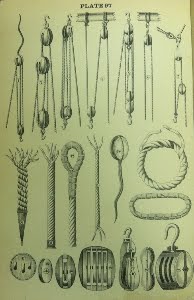
The other day an archivist here had a question about a piece of equipment she found in a photograph. She wasn't sure what it was and asked our historian and the Library staff if we could help. Stephen suggested we break out the Paasch. Paasch sounds like an Easter Egg dying kit, but he is in fact the author of Illustrated Marine Encyclopedia. Paasch, or more formally Capt. H. Paasch, Knight of the Order of "Leopold," of the Imperial Order "Francis Joseph," of the Military Order of "Christ," etc., Member of the Institution of Engineers and Shipbuilders in Scotland, Surveyor to Lloyd's Register for Belgium, Author of "From Keel to Truck," etc. (or at least that is how he has listed himself on the title page...I hope his friends just called him Paasch), is probably better known for his multilanguage dictionary, From Keel to Truck. The Illustrated Marine Encyclopedia was published in response to the success of that title as apparently many readers wrote asking him to expand the English definitions. He accommodated and added material related to merchant service in general. The result is a classic of maritime reference.

What makes Illustrated Marine Encyclopedia so interesting to me (besides the fact that the book is dedicated to "His most Gracious Majesty Leopold II King of the Belgians, Duke of Saxony, Prince of Saxe-Coburg and Gotha, Sovereign of the Independent Congo State"--a controversial dedicatee indeed) are the titular illustrations. The drawings are not only beautiful but so exact that they almost appear to be 3-D. They pop from the page and invite you to invest time in exploring the smallest of the details. The explanations of what exactly (and I do mean exactly) you are looking at are on the opposite page. This is the sort of reference book you could curl up with by a fire. I've included some of my favorites below, but come to the library and see for yourself!

Alphabet

Anchors

Blocks

Fittings and tools

Steam


Mirrored from Full Fathom Five, due to its lack of rss feeds and commenting.

Thursday, September 15, 2011

When running free


When Running Free

When off the wind and going free,
Keep clear of ships close-hauled you see,
And running with the wind dead aft,
Give way to every sailing craft.


Another instructive rhyme from Nautical Nursery Rhymes, by Billy Ringbolt, which resides in the "Peterson, Peter H. (Capt.) Papers, (SAFR 18665, HDC 571)."

(Contributor: Heather Hernandez, Technical Services Librarian)

Mirrored from Full Fathom Five, due to its lack of rss feeds and commenting.

Thursday, September 08, 2011

Red-lined wrasse


The red-lined wrasse (Crenilabrus pavo Linnaeus), plate 6 from the Library's copy of the beautiful book, Taking one's own ship around the world, a journal descriptive of scenes and incidents, together with observations from the log book, recorded on the voyage around the world, October 25, 1928, to May 16, 1929, of the yacht Ara, commanded by the author, William K. Vanderbilt.

Mirrored from Full Fathom Five, due to its lack of rss feed & commenting.