Fan of Full Fathom Five? Be sure to check it out at its new home!
Showing posts with label Archives. Show all posts

Wednesday, March 07, 2012

A Gold Rush Journal 'Round the Horn - More than Latitude and Longitude


(by Palma J. You, Archives Technician)

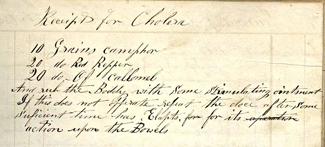
Receipt (recipe) for cholera (SAFR 14200/HDC 91)

The H. W. Chittenden sea journal kept on board the Croton, San Francisco Maritime National Historical Park Museum and Archive Collection (SAFR 14299, HDC 91), gives us a daily perspective from February 16 to July 29, 1849 of life aboard a Gold Rush ship. Mr. Chittenden, an engineer, sailed from New York to San Francisco around Cape Horn. In 19th century language and spelling, his journal is filled with the goings-on and sketches in pencil of sites and landings along the way and other historical information including a provocative remedy for cholera. Sketches and other neat stuff from the journal will be posted over the next several weeks as a series. The first of this series is a remedy for cholera:

Receipt for Cholera
10 grains of camphor
20 do Red Pepper
20 do Of callomel
And rub the Boddy with some stimulating ointment. If this does not opperate, repeat the doce after some suficient time has elapts for its action upon the Bowels.

Here's a nice example of 19th century word usage and spelling. The way the words "Receipt" and "do" are used is intriguing. A little research shows the word "Receipt" could mean "a statement of ingredients and procedure necessary to make a medicinal preparation" - a perfect fit; and "do" is probably the abbreviation of the word "ditto" (OED online). To give "Grains" context, 20 grains make 1 scruple, 480 grains make 1 ounce. In 1888 the United States used the same apothecary scale as used in Great Britain (Clarke). And, "callomel" is listed as a "valuable cathartic given at the beginning of an illness, where it is desired to clean out the bowels completely." (United States Public Health Service). It makes sense this recipe shows up early in the journal.

Etymologies for 19th century usage of the words "Receipt" and "do" can be found in the Oxford English Dictionary. Second edition, 1989; online version December 2011 (subscription required).

Other sources:

Clarke, Frank Wigglesworth. Weights, measures, and money, of all nations. New York: D. Appleton & Co.

Medical Officers of the United States Public Health Service. The Ship's Medicine Chest and first aid at sea. Washington: United States Government Printing Office, 1929.
Mirrored from Full Fathom Five, due to its lack of rss feed & functioning commenting.

Wednesday, October 26, 2011

Stone Boat Yard...


...that's who they were, and that's what we've called them...NOT! (Finding the forgotten partners of the Stone Family boatyards.)

By Sara Diamond, Archivist.

Sometimes a simple fact checking exercise leads to surprising discoveries. That's what happened when I was wrapping up the final details of one of our newer collections, the Jack Ehrhorn collection of Stone Boat Yard naval architectural drawings (HDC1611, SAFR 22826).

I decided to double check the business addresses of the boatyards W. Frank Stone operated in Tiburon from 1893 until 1899, and at Harbor View, in San Francisco, from 1899-1911. Imagine my surprise when I was unable to find a listing for W.F. Stone boatyard in either the San Francisco City Directory or in the Marin County Directory. What I found instead were two previously unacknowledged business partners.

From 1853 until 1975 three generations of the Stone family built some of the most celebrated wooden work, pleasure and racing craft to come from the shores of San Francisco Bay; and until 2004, Stone Boat Yard continued to carry the family name and legacy under new ownership. As the businesses grew and evolved over 141 years, William Isaac Stone, his son W. Frank Stone, and his grandson Lester F. Stone opened and closed boatyards in two San Francisco locations, in Tiburon (Marin), and on both sides of the Oakland-Alameda estuary. In the Historic Documents Department we refer to these boatyards by the shorthand "Stone Boat Yard," and more formally as the W. I. Stone boatyard, the W. F. Stone boatyard, the W. F. Stone & Son boatyard, and finally, as the Stone Boat Yard. These names reflect the history of primary ownership change and were, we assumed, the correct and incorporated business names. Our assumptions were wrong.

I've found a Swann amidst the ducklings of Tiburon. From 1893 to 1899 Frank Stone operated a boatbuilding yard on Beach Street in Tiburon in 1893, in partnership with someone only identified as Swann, and the business was called Stone & Swann. Who was Swann? I don't know! The only information I have comes from a business card which was duplicated on page 62 of James Heig's Pictorial History of Tiburon (San Francisco: 1984). Do you know who Mr. or Ms. Swann was? If so, please leave a comment.

Another heretofore unknown individual person was Edgar N. Van Bergen, Frank Stone's business partner at Harbor View in San Francisco, where they did business as Stone & Van Bergen from 1899 until 1911. After his stint in the shipbuilding business, Edgar Van Bergen became the general manager of a liquor wholesaler on Battery St. in San Francisco. Edgar's path through San Francisco can be followed in the pages of Crocker & Langley's San Francisco City Directories. Do you know anything more about Edgar? If you do, please let us know on the comment page.

I guess the cold fog and sharp wind got on Frank Stone's nerves. In 1912 he moved his home and business to the sunnier side of the bay where he owned and operated a shipyard in partnership with his son, Lester, until his death in 1924. W.F. Stone & Son built wooden boats along the shores of the estuary in Oakland from 1912 to 1941, and in Alameda from 1941 to 1975.

You can find out more about this collection by looking at the finding aid on the Online Archive of California.

Mirrored from Full Fathom Five, due to its lack of rss feed & functioning commenting.

Friday, August 05, 2011

Hydraulic Dredging

Mirrored from Full Fathom Five (it lacks an rss feed & commenting):

(by Mariah Robertson, Archivist)
Hydraulic dredge modelPatent no. 318,859 was designed by Alphonzo B. Bowers and patented in 1885 via the United States Patent Office. Bowers was originally from Maine and moved to the San Francisco area in 1853 and began to design machinery engineered to advance the development of the Bay Area just after the Gold Rush. Nearly 85 years after his passing, the Alphonzo B. Bowers Papers were donated to the Historic Documents Department and have been processed and are open for researcher use.

Hydraulic dredge model, alternate viewA very interesting aspect of this collection is it seems to be an accepted fact that Von Schmidt was the inventor of the hydraulic dredge. But according to the court documents contained in the collection, in 1888, Bowers sued Colonel A.W. Von Schmidt for infringement and won. This suit was the basis for many future lawsuits regarding infringement of his patents. Some of the companies sued were Williams & Bixler, the Golden State and Miners' Iron Works, the San Francisco Bridge Company, the Pacific Coast Dredging and Reclamation Company (San Francisco), L.W. Bates of Chicago, and the New York Dredging Company. An 1897 appeal case ruling declared Bowers to be the inventor of the hydraulic system of dredging. He spent the rest of his life in litigation regarding infringement lawsuits in the United States, Cuba, and other countries.

Wednesday, June 22, 2011

Hal Roth Papers

Mirrored from Full Fathom Five, due to its lack of rss & commenting:


The Hal Roth Papers, 1938-2009 have been cataloged and are now available to researchers. During the work on the collection, Alison Fudge, Archives Technician, wrote:

Margaret and Hal Roth

The Archives recently acquired the collection of Hal Roth, and I am hard at work helping to process the collection so that it will soon be ready to share with researchers. Roth was a noted seaman and author who sailed around the world with his wife, Margaret, aboard their yacht Whisper, and wrote 13 books and numerous articles regarding their journeys.

Roth's travels took him to many faraway locales, including French Polynesia, the Mediterranean, South America, Japan, and around Cape Horn. In 1971, he was awarded the Blue Water Medal from the Cruising Club of America for his circumnavigation of the Pacific Basin.

He was also an accomplished photographer who studied under Ansel Adams and Edward Weston. In addition to an extensive representation of maritime photography, the collection also includes beautiful images of California landscapes and San Francisco's Chinatown.

There are so many treasures waiting to be discovered!

Monday, March 14, 2011

Do you have traveling plans?

Mirrored below is Palma J. You's new post from over at Full Fathom Five, Do you have traveling plans?


We do! Prior to the digital revolution, marine engineering plans often needed to travel between builders, owners, consultants and architects. Document tubes were used to protect plans while in transport. I am currently processing a large (94 linear feet) collection donated by Pillsbury & Martignoni, Naval Architects and Marine Engineers of San Francisco who were in business during the first half of the 20th century. Most of the plans inventoried thus far relate to tugs, towboats, sport fishing boats, freighters, barges and passengers vessels. Very interesting, but I also find the storage tube an interesting pre-plastic artifact.

The two varieties of materials used in construction of traveling tubes for this marine engineering firm are aluminum and fiber board. The plans stored inside are circa 1943-1965. More on the plans stored inside the tubes next time!


--Contributor: Palma J. You, Archives Technician

Wednesday, November 17, 2010

Libraries, Archives, Special Collections Jobs

Rachael Cristine Woody at the Smithsonian's Freer|Sackler Archives posted "How Can I Get a Job? (Libraries, Archives and Special Collections)" on Oct. 20, 2010, at the Smithsonian Collections blog.

She links to great resources for finding job and educational opportunities in museum libraries and archives, and provides sound advice--and links to more resources--for building a resume rich in social media experience as well as solid grounding in professional standards.

Also of interest to those already in the profession, are the statistics she reports:

Bureau of Labor Statistics 2010-2011 edition for Archivists, Curators and Museum Technicians, you'll see the profession is projected to grow a faster than average 20% by 2018. The statistics for Librarians are also expected to grow at least 8% and job competition to be favorable to potential employees as many librarians retire in the coming years.


Head over there to follow her links to the relevant Bureau of Labor Statistics sites for more info!

Saturday, August 07, 2010

Calisphere

Harry Monahan carving scroll on the C.A. ThayerThe University of California's Calisphere describes itself as, "A world of primary sources and more." If you're looking for specific, primary resources, the search box (on the upper right of the site) returns easily navigated results under a button bar that lets you choose images, texts, or websites, with an additional "search within results" box for easy limiting. And although the site is sponsored by the University of California, it includes resources from many repositories, large and small, and the resources are not limited to those relating to California history--for example, the Grunwald Center for the Graphic Arts, UCLA Hammer Museum, has contributed images from Hiroshige's Thirty-six Views of Mt. Fuji.

A great strength of the site, though, are the collections for educators which lead to sites external to Calisphere, such as UC San Diego's California Explores the Oceans--Expeditions site, as well as Calisphere sites on topics like Richmond Shipyards.

As for maritime resources, the site contains thousands of items related to boats, ships, shipbuilding, etc. And although the site is rich, it's not comprehensive--it doesn't contain all of the resources from the contributing repositories--it's a curated collection, and a great place to start one's research.

Wednesday, June 30, 2010

London Lives from Straddling the World of the Written Word

Joan Druett has featured yet another wonderful resource on her blog, Straddling the World of the Written Word, in her post, Handwritten Records of 18th century London Online. The site, London Lives, contains some maritime treasure.

The search box on the home page seeks name or reference ID, but if you select More Search Options (below the black Search button), you can then select Keyword search on the next screen (to the right of the green Search button). Here is the Keyword Search screen where you can search by occupations, such as sailor, seaman, captain or such words as frigate.

To browse tags, be sure to select the Lives link (on the left navigation pane), and you will see the fascinating tag cloud on the lower right of the screen, as well as a list of people, whose biographies have been written.

Genealogists may wish to consult the FAQ (located in the navigation pane on the left under "About This Project"), and historians may want to consult the Copyright and Citation Guide.

The site also reveals a wealth of information under About This Project, including their technical methods, which is fascinating for those considering or involved with similar digitization projects.

Tuesday, April 14, 2009

Google Life images


Have you explored the Life photo archive on Google images yet? There are many, many maritime images. A fast way to start searching is to go directly to Google Image Search, images.google.com and in addition to your search terms, enter: source:life

If you'd like to browse by decade or topic, head to the collection's site, where a few topics are listed, and photo collections by decade from the 1860s to the 1970s are available.

Thursday, April 09, 2009

vads

vads, "the online resource for visual arts," has many images of interest to the maritime community. There is a link to the separate collections for easy browsing, but the search tool is excellent. Searching for "ship" returned images of ships as expected, but also of tableware used on ships, nautical fashions, and a toy cargo ship. The descriptions are thorough, and many types of images are included--photographs, paintings, posters and prints.

Thursday, April 02, 2009

New Villiers resources, and pirates!

Douglas McCarthy (with the Picture Library at NMM, Greenwich), sends along some wonderful new resources. First, new collections are available at nmmimages.com, the Picture Library online:

Pirates: Buccaneers, treasure, dastardly deeds aplenty (real and fictional). This is a wonderful collection, including famous, familiar images, and delightful surprises such as the pirates dressed as women to try to fool a merchant ship.

Alan Villiers: life in the last days of sail. A talented photographer, Villiers' images are full of life and beauty.

In addition to these large collections of images, the Museum has just published a new book on Villiers, Alan Villiers: Voyager of the Winds by Kate Lance.

Even if you don't think you'll buy the book, go to its website and follow the links on the right side of the page--there's a clip from his film, "The Cape Horn Road" (don't miss the adorable cat!), and links to Villiers photos both on the nmmimages.com site and on Flickr commons.

Thank you, Douglas!

Tuesday, February 24, 2009

Great War archives

The Great War Archive contains over 6,500 items contributed by the general public during 2008, and continues to grow through its sister-site, the Great War Archive Flickr group. There is a wealth of maritime-related images here; just searching ship turns up pages and pages of images.

The Great War Archive is hosted by the University of Oxford, as is The First World War Poetry Digital Archive, where one can find Robert Graves' poem, "I wonder what it feels like to be drowned" (retrievable through the search ships).

Tuesday, December 23, 2008

Nautical paper plates of yesteryear

"Paper plate ad, couple at dock," from George Eastman House's Flickr photostream.

More information on the George Eastman House photography collection is available at their website.

Tuesday, December 09, 2008

The Naval History Society Collection, 1721-1995

Celia Hartmann, Project Archivist, Naval History Society Collection at the New-York Historical Society has sent along exciting news:

The New-York Historical Society has made available the finding aid for its newly processed Naval History Society Collection. You can find it at http://dlib.nyu.edu/findingaids/html/nyhs/NHSColl.html
where it is fully searchable.

The Collection consists of 53 individual collections, many named for renowned naval officers or vessels. These include correspondence, letterbooks, journals and diaries, lectures, essays, account books, biographical writings, genealogical information, scrapbooks, orders, notes, articles and clippings, photographs, manuscripts, and ships' logs, as well as the organizational records and correspondence of the Naval History Society itself.

The majority of the collections document American naval engagements and commercial maritime pursuits, personalities, and vessels; a few collections of British and French documents are included. The Collection as a whole provides primary sources on American naval involvement in hostilities from the American Revolution to the Spanish American War, as well as routine commercial and naval shipboard life, naval design, navigation, education and officer training. The Society's records document the founding, management, and activities of a collecting and publishing organization in the first third of the 20th century.

Processing of the Collection was made possible by the Gladys Krieble Delmas Foundation.

The finding aid is a thing of beauty; easy to navigate, each of the series is linked to the relevant container list. Related material is covered, and under "Access restrictions," it's noted that microfilms of portions of the collection are available via interlibrary loan! The access points are easily browsed, and also hyperlinked, covering names, subjects, and even document types.

The only item that seems missing in the finding aid is a link for further information, so researchers take note: Celia will be there to answer questions until the end of the month. After that, contact the reference staff at the New York Historical Society. (If their website is unavailable, try phoning 212-873-3400.)

ETA: The finding aid now has a link for further information: select List of Finding Aids to see more finding aids, a link to the institution's home, etc. (Feb. 25, 2009)