Fan of Full Fathom Five? Be sure to check it out at its new home!

Thursday, October 06, 2011

New in the SF Maritime NHP Library


Here are the Library's lists of new accessions for the last half of June through the first half of August; for more information on any title, contact us or search our catalogs:


Mirrored from Full Fathom Five, due to its lack of rss feed & functioning commenting.

Thursday, September 29, 2011

Two steamers meeting, and passing


Two Steamers Meeting

When both side lights you see ahead,
Port your helm and show your RED.

Two Steamers Passing

GREEN to GREEN, or RED to RED--
Perfect safety--go ahead.

Another instructive rhyme, addressing vessel sidelights, from Nautical Nursery Rhymes, by Billy Ringbolt, which resides in the "Peterson, Peter H. (Capt.) Papers, (SAFR 18665, HDC 571)."

(Contributor: Heather Hernandez, Technical Services Librarian)

Mirrored from Full Fathom Five, due to its lack of rss feeds and commenting.

Wednesday, September 21, 2011

Digging for Gold at the Library: Paasch


(by Gina Bardi, Reference Librarian)

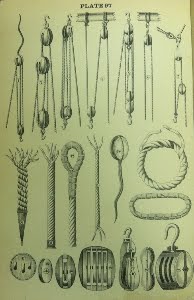
The other day an archivist here had a question about a piece of equipment she found in a photograph. She wasn't sure what it was and asked our historian and the Library staff if we could help. Stephen suggested we break out the Paasch. Paasch sounds like an Easter Egg dying kit, but he is in fact the author of Illustrated Marine Encyclopedia. Paasch, or more formally Capt. H. Paasch, Knight of the Order of "Leopold," of the Imperial Order "Francis Joseph," of the Military Order of "Christ," etc., Member of the Institution of Engineers and Shipbuilders in Scotland, Surveyor to Lloyd's Register for Belgium, Author of "From Keel to Truck," etc. (or at least that is how he has listed himself on the title page...I hope his friends just called him Paasch), is probably better known for his multilanguage dictionary, From Keel to Truck. The Illustrated Marine Encyclopedia was published in response to the success of that title as apparently many readers wrote asking him to expand the English definitions. He accommodated and added material related to merchant service in general. The result is a classic of maritime reference.

What makes Illustrated Marine Encyclopedia so interesting to me (besides the fact that the book is dedicated to "His most Gracious Majesty Leopold II King of the Belgians, Duke of Saxony, Prince of Saxe-Coburg and Gotha, Sovereign of the Independent Congo State"--a controversial dedicatee indeed) are the titular illustrations. The drawings are not only beautiful but so exact that they almost appear to be 3-D. They pop from the page and invite you to invest time in exploring the smallest of the details. The explanations of what exactly (and I do mean exactly) you are looking at are on the opposite page. This is the sort of reference book you could curl up with by a fire. I've included some of my favorites below, but come to the library and see for yourself!

Alphabet

Anchors

Blocks

Fittings and tools

Steam


Mirrored from Full Fathom Five, due to its lack of rss feeds and commenting.

Thursday, September 15, 2011

When running free


When Running Free

When off the wind and going free,
Keep clear of ships close-hauled you see,
And running with the wind dead aft,
Give way to every sailing craft.


Another instructive rhyme from Nautical Nursery Rhymes, by Billy Ringbolt, which resides in the "Peterson, Peter H. (Capt.) Papers, (SAFR 18665, HDC 571)."

(Contributor: Heather Hernandez, Technical Services Librarian)

Mirrored from Full Fathom Five, due to its lack of rss feeds and commenting.

Thursday, September 08, 2011

Red-lined wrasse


The red-lined wrasse (Crenilabrus pavo Linnaeus), plate 6 from the Library's copy of the beautiful book, Taking one's own ship around the world, a journal descriptive of scenes and incidents, together with observations from the log book, recorded on the voyage around the world, October 25, 1928, to May 16, 1929, of the yacht Ara, commanded by the author, William K. Vanderbilt.

Mirrored from Full Fathom Five, due to its lack of rss feed & commenting.

Thursday, September 01, 2011

What d'ya mean by "Crow's nest?"


 Golden Hind Model (SAFR 22687)

A sailor get's a bird's-eye view of his environment from a crow's nest. Galleons of the 16th century often had one or more crow's nests situated high on the tallest masts, where a sailor often shared this lofty perch with crows brought aboard in a cage, hence the term, "crow's nest." If the captain wanted to locate land, a crow was released from the perch and the navigator sailed in the direction of the bird's flight as it invariably headed towards land. Modern mates use the term to describe any kind of protected station fitted aloft to accommodate a lookout.

Detail of the model

The Park's full hull model artifact, English galleon Golden Hind, catalog number SAFR 22687, has excellent examples of crow's nest perches on the main and foremast. See it for yourself. The Golden Hind is currently on exhibit in the Prismatarium room of the Museum Building.

Citations:

Rogers, John G. Origins of sea terms. Mystic, Conn.: Mystic Seaport Museum, 1984.
MacEwen, William A. and A.H. Lewis. Encyclopedia of nautical knowledge. Cambridge, Md.: Cornell Maritime Press, 1953.

--Contributor: Palma J. You, Archives Technician.


Mirrored from Full Fathom Five, due to its lack of rss feeds & commenting.

Wednesday, August 24, 2011

With Wind on Same Sides


Here's another instructive rhyme from Nautical Nursery Rhymes by Billy Ringbolt, which resides in the "Peterson, Peter H. (Capt.) Papers," (SAFR 18665, HDC 571):


"With Wind on Same Sides"

When vessels are sailing with wind the same side,
To continue their course they might foul or collide,
The one that's to windward is the one to keep clear,
From her course give the other no reason to sheer.


(Contributer: Heather Hernandez, Technical Services Librarian)

Mirrored from Full Fathom Five, due to its lack of rss feeds and commenting.

Wednesday, August 17, 2011

New in the SF Maritime NHP Library


Here are the Library's lists of new accessions for the last half of June through the first half of August; for more information on any title, contact us or search our catalogs:


Mirrored from Full Fathom Five, due to its lack of rss feed & functioning commenting.

Thursday, August 11, 2011

Digging for gold at the Library: Cramp's Shipyard


(by Gina Bardi, Reference Librarian)

The other day I was walking through the stacks and I caught a glint of gold. Now, I am neither a bird nor a rat nor a raccoon nor Gollum, but when I see something shiny, I must investigate further.

What caught my eye was a 1920 book entitled Cramp's Shipyard. In the picture below it is difficult to see how nice the cover is. It's more gold than yellow.

Cover of book

"Shiny!"

The book is a brief history of the William Cramp and Sons Ship and Engine Building Company, the I.P. Morris Company, and the Kensington Shipyard Co. Most of the slim volume is photos of their various ships which is nice, but we've seen images like those a million times. The thing that knocked my socks clean off (I'm still looking for them...if you see a pair of rainbow toe socks anywhere, they're mine) are the beautiful photographs of the equipment and machinery. Some of these things don't look like they belong of this temporal world. Rather, they look as if they should be in a Dr. Seuss book or in the movie Metropolis. I submit for your approval:

Hydraulic turbine

Where do those tubes go, I wonder? Willy Wonka's Shipbuilding Factory?

Piston rods

Anyone up for a game of pool?

Marine machinery

Marine machinery

It's reminiscent of Dr. Doolittle's snail, no?

Marine machinery with men

Hooooooonk! It calls to mind an ungainly instrument.

Marine machinery with men

I wish this was my playhouse.

Come by the library anytime to check out Cramp's Shipyard and drool over the wonderous machines.


Mirrored from Full Fathom Five, due to its lack of rss feed & functioning commenting.

Friday, August 05, 2011

Hydraulic Dredging

Mirrored from Full Fathom Five (it lacks an rss feed & commenting):

(by Mariah Robertson, Archivist)
Hydraulic dredge modelPatent no. 318,859 was designed by Alphonzo B. Bowers and patented in 1885 via the United States Patent Office. Bowers was originally from Maine and moved to the San Francisco area in 1853 and began to design machinery engineered to advance the development of the Bay Area just after the Gold Rush. Nearly 85 years after his passing, the Alphonzo B. Bowers Papers were donated to the Historic Documents Department and have been processed and are open for researcher use.

Hydraulic dredge model, alternate viewA very interesting aspect of this collection is it seems to be an accepted fact that Von Schmidt was the inventor of the hydraulic dredge. But according to the court documents contained in the collection, in 1888, Bowers sued Colonel A.W. Von Schmidt for infringement and won. This suit was the basis for many future lawsuits regarding infringement of his patents. Some of the companies sued were Williams & Bixler, the Golden State and Miners' Iron Works, the San Francisco Bridge Company, the Pacific Coast Dredging and Reclamation Company (San Francisco), L.W. Bates of Chicago, and the New York Dredging Company. An 1897 appeal case ruling declared Bowers to be the inventor of the hydraulic system of dredging. He spent the rest of his life in litigation regarding infringement lawsuits in the United States, Cuba, and other countries.

Thursday, July 28, 2011

What time is it?

Mirrored from Full Fathom Five (it lacks rss feeds & commenting):

Aboard a ship, time is told by the striking of the ship's bell. Charts at the Antique Horology website, and the Wikipedia article, illustrate how many bells at what time. In the library we have extensive collections of ephemeral items, and this handy chart is part of our file of printed ephemera dealing with bells--it illustrates the system graphically:


What time is it where you are? How many bells?

Thursday, July 21, 2011

What d'ya mean by "Donkey's Breakfast?"


A "donkey's breakfast" is "a sailor's nickname for a straw mattress, issued in some forecastles in the early 19th century."

(Source: Rogers, John G. Origins of sea terms.)

And, what's a "forecastle?" "A forward living compartment for the crew."

(Source: Kerchove, Rene de. International maritime dictionary.)

(Contributors: Palma J. You, Archives Technician & Heather Hernandez, Technical Services Librarian)


--Mirrored from Full Fathom Five due to its lack of rss feed & commenting.

Wednesday, July 13, 2011

Digging for Gold at the Library: Shipshape

Mirrored from Full Fathom Five, due to its lack of rss feed & commenting:

(by Gina Bardi, Reference Librarian)

In my last post, we discussed what to pack on an ocean voyage. So now that you are sure to look your best, we’ll move on to what to do when you’re under way (besides standing there looking fabulous).

The book Shipshape or Sea-legs Without Tears by Edmund Vale will be our guide. Written in 1931, Shipshape has excellent advice for the novice traveler. There’s scads of technical information--entire chapters devoted to the Engine Room and the Bridge, for instance. But let’s be honest. What we care about is the nitty-gritty on the social scene. That’s where Shipshape shines. For example, the third most important thing to do as soon as you board (after finding your room and noting the time of breakfast) is to "fix the time of your bath" (177). Would you have had the forethought to do that on your own? No, of course not. The rest of your voyage would be spent sneaking in baths willy-nilly, haphazardly washing yourself in an unscheduled manner. It’s simply not decent.


Caption: Unfixed bath times result in chaos and anarchy.


Shipshape also gives the low down on the officers. "The captain is generally polite but a silent man" and "If you want liveliness, it will be bad luck, should you sit at the doctor’s table and not get it" (178) and "Your modern Steward is human, almost humane" (184).


Caption: This guy would beg to differ with that statement.


But the most intriguing part of Shipshape is the chapter dealing with deck games. In my last post, we discussed what to wear while playing quoits. Now, we finally learn what quoits is. Or at least you would have learned, but I’ve decided to cut the quoits description to focus instead on Bumble Puppy.


Caption: BUMBLE PUPPIES!


The name of the game is actually more thrilling than the game itself, which is basically tetherball on a ship. But if you are on a ship and are anxious to make friends, I recommend suggesting a friendly game of Bumble Puppy. Who could refuse such an offer?


Caption: Play Bumble Puppy with me! (photo credit Nixx Photography)

Wednesday, July 06, 2011

Ships on the Shore

For those of you reading the blog via your feeds, I wanted to call your attention to an addition to our blog roll, Ships on the Shore, a very interesting blog where Jamin Wells writes about shipwrecks--news, research, and the thoughts of one who studies them.

Thanks to Jamin for alerting me to Ships on the Shore!

Wind on Different Sides

Mirrored from Full Fathom Five, due to its lack of commenting & rss feed:

Here's another instructive rhyme from Nautical Nursery Rhymes by Billy Ringbolt, which resides in the Park's Peterson, Peter H. (Capt.) Papers (SAFR 18665, HDC 571):

Wind on Different Sides

With wind on starboard you hold right of way,
But with it to port you must not delay
To do what is best in order to steer
Quite clear of the other and not interfere.

Tuesday, June 28, 2011

New in the SF Maritime NHP Library

Mirrored from Full Fathom Five, due to its lack of rss feeds & commenting:

Here are the Library's lists of new accessions for the last half of April and the first half of May; for more information on any title, contact us, or search our catalogs:

Wednesday, June 22, 2011

Hal Roth Papers

Mirrored from Full Fathom Five, due to its lack of rss & commenting:


The Hal Roth Papers, 1938-2009 have been cataloged and are now available to researchers. During the work on the collection, Alison Fudge, Archives Technician, wrote:

Margaret and Hal Roth

The Archives recently acquired the collection of Hal Roth, and I am hard at work helping to process the collection so that it will soon be ready to share with researchers. Roth was a noted seaman and author who sailed around the world with his wife, Margaret, aboard their yacht Whisper, and wrote 13 books and numerous articles regarding their journeys.

Roth's travels took him to many faraway locales, including French Polynesia, the Mediterranean, South America, Japan, and around Cape Horn. In 1971, he was awarded the Blue Water Medal from the Cruising Club of America for his circumnavigation of the Pacific Basin.

He was also an accomplished photographer who studied under Ansel Adams and Edward Weston. In addition to an extensive representation of maritime photography, the collection also includes beautiful images of California landscapes and San Francisco's Chinatown.

There are so many treasures waiting to be discovered!

Wednesday, June 15, 2011

Play cribbage like a sailor

Mirrored from Full Fathom Five, due to its lack of rss feed & commenting functions:

If you search our Museum Web Catalog, you'll find several examples of cribbage boards such as the one below. Popular for centuries, today in the U.S. alone it is played by over 10 million people!

Cribbage Board in the shape of a seal

Want to learn how to play the way they did in the 19th century? The Cribbage Player's Text-book, Being a New and Complete Treatise on the Game in all its Varieties (1837) is available online for free from the Internet Archive. If you're interested in a contemporary outline of how to play the game, the Wikipedia article is a good place to start; the links at the bottom of the article lead to cribbage associations, forums, and much more. If you're looking for a handy book to refer to while playing, either Scarne's Encyclopedia of Card Games or According to Hoyle : official rules of more than 200 popular games of skill and chance, with expert advice on winning play, will soon have you playing like a sailor.

Citation: "Cribbage." Encyclopaedia Britannica. Encyclopaedia Britannica Online Library Edition. Encyclopaedia Britannica, 2011. Web. 7 Mar. 2011. .

Wednesday, June 08, 2011

Digging for Gold at the Library: Sea Monsters!

Mirrored from Full Fathom Five:

by Gina Bardi, Reference Librarian)

If you're getting ready to take an ocean voyage, there are some staples you would pack: sunglasses, a set of quoits, a bathing suit with matching cape and most importantly, Monsters of the sea, legendary and authentic:
Cover of: Monsters of the sea, legendary and authentic
Because you would hate to be lounging in a deck chair sipping a scorpion and suddenly see a strange shape in the ocean and not be able to identify it as an American Sea Serpent or a Mediterranean one. Think how people would laugh at you! For reference purposes:
American Sea Serpent from: Monsters of the sea, legendary and authentic
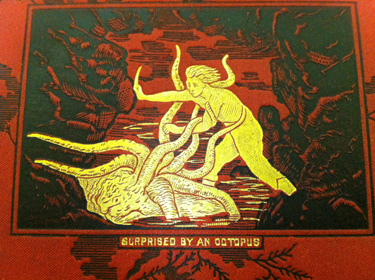
No, you must be prepared on your voyage. As the book points out in a beautiful detail on its cover, do you really want to be surprised by an octopus?
Surprised by an Octopus, from: Monsters of the sea, legendary and authentic
I think not. Surprises should involve parties, cakes and jewelry--not knife fighting cephalopods.

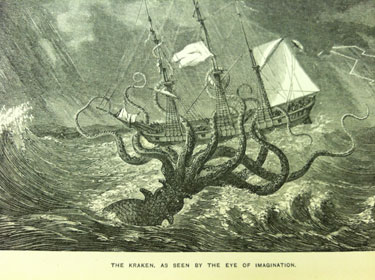
If you'd like to see John Gibson's Monsters of the sea, legendary and authentic, stop by the Library. There are sixteen other wonderful illustrations along with all the information you need to astound and amaze your fellow travelers while playing quoits.
Kraken, from: Monsters of the sea, legendary and authentic.
Who let the Kraken out?

Wednesday, June 01, 2011

New in the SF Maritime NHP Library

Mirrored from Full Fathom Five, due to its lack of rss feed:

Here are the Library's lists of new accessions for the last half of April and the first half of May; for more information on any title, contact us, or search our catalogs: